
The Changing Landscape Of Hypnotherapy
Modern hypnotherapy has a surprisingly rich and dramatic history, one that weaves together surgery, dentistry, eccentric pioneers and major medical breakthroughs. Understanding this journey not only helps explain why hypnotherapy has been misunderstood for so long, but also why it is now experiencing a well‑deserved resurgence. This narrative is essential to grasping the full History of Hypnotherapy.
At the heart of this story are two very different developments happening at almost the same moment in history: the rise of hypnosis as a medical tool, championed in Edinburgh by James Braid, and the discovery of chloroform, which rapidly changed how pain was managed across medicine.

Hypnosis Before Modern Medicine
Long before hypnotherapy was named or studied scientifically, altered states of focused attention were used for healing across cultures. From ancient sleep temples to ritual and suggestion‑based healing, humans have long understood, intuitively, that the mind plays a powerful role in pain and recovery.
By the 18th century, these ideas began to attract public attention through figures such as Franz Anton Mesmer. Mesmer believed healing occurred through invisible magnetic forces within the body, a theory that would later be dismissed. While his explanations were flawed, his demonstrations revealed something important: suggestion and focused attention could dramatically influence perception, behaviour and pain.
Unfortunately, Mesmer’s theatrical style and mystical explanations did lasting damage. His eccentricity blurred the line between serious medical inquiry and spectacle, contributing to misconceptions about hypnosis that still linger today.
James Braid: Bringing Hypnosis into Science
The turning point came with James Braid, a Scottish surgeon practising in Edinburgh in the mid‑1800s. Unlike Mesmer, Braid approached hypnosis with a clinical eye.
After observing mesmerist demonstrations, Braid concluded that the effects had nothing to do with magnetism. Instead, he recognised hypnosis as a natural physiological and psychological state, brought about by focused attention and mental concentration.
In 1843, he introduced the term hypnosis and began documenting its effects scientifically. Crucially, Braid explored hypnosis as a method of pain relief during surgery, moving it firmly into the medical arena.
Hypnosis in Surgery and Amputation
Before chemical anaesthesia, surgery was brutal. Patients were awake, restrained and fully conscious, including during amputations, which were often performed quickly to minimise suffering.
Hypnosis offered a remarkable alternative. There are documented cases of patients undergoing major surgical procedures, including amputations, while hypnotised, experiencing little or no pain.
Had this approach continued to develop, hypnosis might have become a standard medical skill. It required no equipment, no chemicals, and could be used anywhere, even in field hospitals, where resources were limited and conditions were far from ideal.
Chloroform: A Medical Game‑Changer
The discovery of chloroform in the 1840s, notably advanced by Edinburgh physician James Young Simpson, transformed medicine almost overnight.

Chloroform offered doctors something irresistible: fast, reliable unconsciousness. Unlike hypnosis, it did not depend on a patient’s focus, emotional state or responsiveness. Anyone could administer it, including in battlefield hospitals and emergency surgical settings.
For amputations and major surgery, chloroform was revolutionary. Pain could be eliminated quickly and predictably, and surgical outcomes improved dramatically.
But this convenience came at a cost.
How Chloroform Redirected Hypnotherapy

As chemical anaesthesia became widespread, hypnosis was gradually pushed out of surgical medicine. It was seen as slower, less controllable and harder to standardise.
However, rather than disappearing, hypnosis found a new role.
It evolved into a therapeutic tool for:
- Behavioural change and habit work
- Pain management outside surgery
- Anxiety and phobia treatment
- Emotional and psychological healing
Ironically, chloroform did not make hypnosis obsolete, it freed hypnotherapy to become what it truly excels at: working with the subconscious mind.
Hypnosis and Dentistry: A Quiet Continuation
While mainstream medicine moved on, hypnosis never completely vanished.
In dentistry, hypnotherapy continued to be explored and taught for pain management and dental anxiety. Even today, hypnotic techniques are used and studied to help patients manage fear, discomfort and gag reflexes, particularly for those who struggle with conventional approaches.
This quiet continuation kept hypnosis grounded in healthcare, even while public perception drifted towards stage shows and entertainment.
Misconceptions and the Shadow of Showmanship
Much of hypnotherapy’s reputation problem stems from its early association with showmanship. Figures like Mesmer, though historically important, inadvertently fuelled the idea that hypnosis was about control, mysticism or spectacle.
In reality, hypnotherapy is none of these things.
Modern hypnotherapy is:
- Client‑led
- Ethical and evidence‑informed
- Grounded in neuroscience and psychology
- Focused on collaboration, not control
The myths persist, but they are increasingly being challenged by scientific understanding.
Other Pioneers of the Mind: Charcot, Freud and a Changing Focus
While hypnosis was being reshaped, and in some cases sidelined, other influential figures were also exploring the workings of the mind, each leaving a lasting mark on modern psychology.
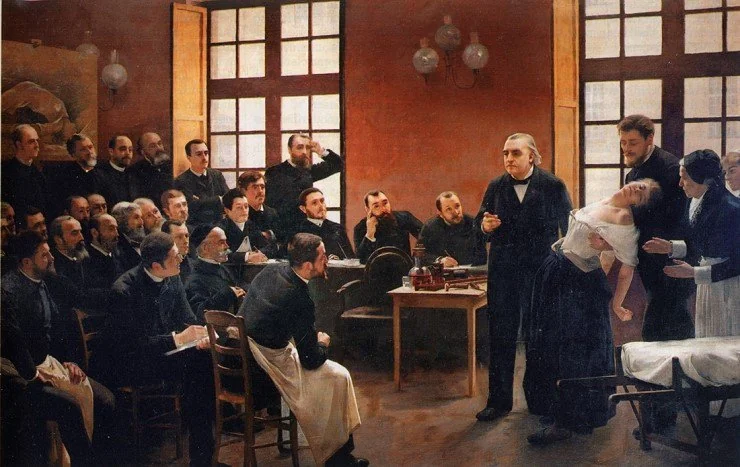
In France, neurologist Jean-Martin Charcot studied hypnosis in clinical settings, particularly with patients experiencing what were then labelled as hysterical symptoms. Charcot viewed hypnosis as a neurological phenomenon and helped legitimise it within medical circles, though his work also reinforced the idea that hypnosis was something unusual or pathological, rather than a natural state accessible to many.
Among those influenced by Charcot was Sigmund Freud, who initially used hypnosis in his early clinical practice. Freud later moved away from hypnosis in favour of psychoanalysis, believing that insight gained through conscious exploration was more reliable. This shift had a profound impact: as psychoanalysis grew in popularity, hypnosis was increasingly seen as outdated or inferior, despite its effectiveness.
Ironically, many techniques used in modern hypnotherapy, such as guided imagery, free association and working with unconscious material, closely resemble the processes Freud himself developed, simply approached through a different doorway.
Together, these pioneers helped move the study of the mind forward, but their differing interpretations also fragmented the field. Hypnosis became just one branch of a rapidly expanding psychological landscape, rather than the central focus it might once have been.
A Return to Understanding the Mind–Body Connection
Today, hypnotherapy is experiencing a resurgence, not because it is new, but because science has caught up.
Research into neuroscience, neuroplasticity and nervous system regulation confirms what early practitioners observed: the mind profoundly influences the body.
Hypnotherapy now sits comfortably alongside modern approaches to anxiety, pain management, trauma and performance, offering a gentle and holistic complement to conventional treatment.
Where Hypnotherapy Stands Today
At BMA Hypnotherapy, modern practice honours this full journey, from its medical roots to its present‑day application. Hypnotherapy is approached with professionalism, compassion and respect for both science and individual experience.
Far from being a fringe therapy, hypnotherapy is reclaiming its place as a powerful tool for healing, self‑understanding and change.
Sometimes progress doesn’t move in a straight line – it circles back, bringing wisdom with it.
